
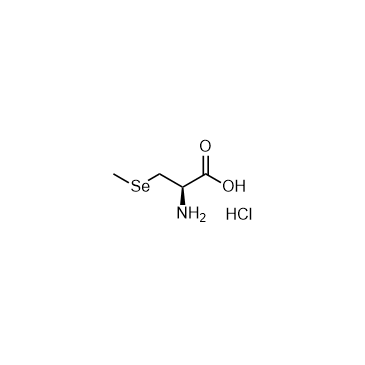
Se-Methylselenocysteine (hydrochloride)
CAS No. : 863394-07-4
(Synonyms: Methylselenocysteine (hydrochloride); Se-Methylseleno-L-cysteine (hydrochloride))
| Size | Price | Stock |
|---|---|---|
| 100 mg | Get quote | |
| 250 mg | Get quote | |
| 500 mg | Get quote | |
| We match the lowest price on market. | ||
We offer a substantial discount on larger orders, please inquire via [email protected]
or Fax: (86)21-58955996
Inquiry for price and availability only. Please place your order via our email or fax.
| Cat. No. : | HY-114245B |
| M.Wt: | 218.54 |
| Formula: | C4H10ClNO2Se |
| Purity: | >98 % |
| Solubility: | 10 mM in DMSO |
Se-Methylselenocysteine hydrochloride, a precursor of Methylselenol, has potent cancer chemopreventive activity and anti-oxidant activity. Se-Methylselenocysteine hydrochloride is orally bioavailable, and induces apoptosis[1][2]. In Vitro: Se-Methylselenocysteine hydrochloride (100-400 μM; 3 days) induces apoptosis in SKOV-33 cells[1].
Se-Methylselenocysteine hydrochloride (100-400 μM; 3 days) induces caspase-3 mediated apoptosis[1]. In Vivo: Se-Methylselenocysteine hydrochloride (0.2 mg/mouse; p.o.; daily for 14 days) potentiates the antitumour activity of CDDP and Cyclophosphamide in nude mice bearing human FaDu and A253 head and neck xenografts[2].
Alzheimer's disease (AD) mice are treats with Se-Methylselenocysteine hydrochloride (0.75 mg/kg BW per day) in their drinking water for 10 months. Se-Methylselenocysteine hydrochloride reduces oxidative stress and neuro-inflammation; Se-Methylselenocysteine hydrochloride modulates the distribution and levels of several metal ions; Se-Methylselenocysteine hydrochloride decreases amyloid-β peptide (Aβ) generation by inhibiting the expression of its precursor protein APP and β-secretase (BACE1), and attenuates tau hyperphosphorylation and neurofibrillary tangles (NFT) formation via promoting protein phosphatase 2A (PP2A) activity, thereby preserving synaptic proteins and neuron activities and finally improving spatial learning and memory deficits in AD model mice[3].
Lorem ipsum dolor sit amet, consectetur adipisicing elit. Autem earum hic iste maiores, nam neque rem suscipit. Adipisci consequatur error exercitationem fugit ipsam optio qui, quibusdam repellendus sed vero! Debitis.
Inquiry Information- Product Name:
- Se-Methylselenocysteine (hydrochloride)
- Cat. No.:
- HY-114245B
- Quantity:
Your information is safe with us.