
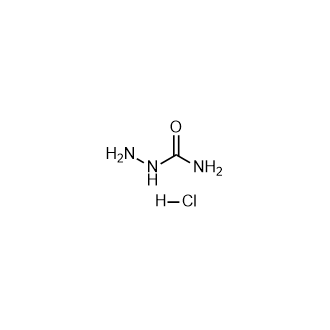
Semicarbazide (hydrochloride)
CAS No. : 563-41-7
(Synonyms: Aminourea (hydrochloride); Hydrazinecarboxamide (hydrochloride))
| Size | Price | Stock |
|---|---|---|
| 100g | $10 | In-stock |
| 500g | $27 | In-stock |
| 1000g | $53 | In-stock |
| > 2 kg | Get quote | |
| We match the lowest price on market. | ||
We offer a substantial discount on larger orders, please inquire via [email protected]
or Fax: (86)21-58955996
Inquiry for price and availability only. Please place your order via our email or fax.
| Cat. No. : | HY-Y0470 |
| M.Wt: | 111.53 |
| Formula: | CH6ClN3O |
| Purity: | >98 % |
| Solubility: | DMSO : 100 mg/mL (ultrasonic);H2O : 100 mg/mL (ultrasonic) |
Semicarbazide hydrochloride is an orally active urea derivative. Semicarbazide hydrochloride binds to copper or iron in cells. Semicarbazide hydrochloride inhibits the activity of soluble semicarbazide sensitive amine oxidase (SSAO). Semicarbazide hydrochloride damages cartilage, blood vessels, ovaries, testicles, and thyroid follicles[1][2][3][4][5][6][7][8][9].
In Vitro:Semicarbazide (1 mM) hydrochloride inhibits the activity of soluble SSAO in vitro[2].
In Vivo:Semicarbazide hydrochloride (10-250 ppm in diet; p.o.; daily; 52 weeks for chronic toxicity study and 104 weeks for carcinogenicity study) causes enlargement of knee joints, reduces body weight, and histopathological changes in bone, cartilage and aorta, but shows no carcinogenicity in rats[3].
Semicarbazide hydrochloride (500-1,000 ppm in diet; p.o.; daily; 4 weeks) causes more severe osteochondral and vascular lesions in 3-week-old female SD rats compared to 20-week-old female SD rats[4].
Semicarbazide (40 mg/kg body weight; p.o.; daily; 4 weeks) hydrochloride causes distortion and degeneration of thyroid follicles in juvenile male albino rats, and most of the follicles appear normal after 4-week recovery[5].
Semicarbazide hydrochloride (40 mg/kg body weight; p.o.; daily; 4 weeks) causes a significant drop in body weight, GnRH, LH, FSH and E2 hormone levels, and histopathological alterations in ovarian tissues of adult female albino rats[6].
Semicarbazide (40 mg/kg; p.o.; daily; 4 weeks) hydrochloride causes significant structural changes in juvenile seminiferous tubules of rat testis, including vacuolated spermatogenic and Sertoli cells, discontinuity of germinal epithelium and thickened basement membrane[7].
Semicarbazide (40-140 mg/kg; p.o.; daily; 28 days) hydrochloride causes mortality at high and mid-dose levels, decreased body weight gain in male rats even at the lowest dose, lack of mineralization in cartilage at all dose levels, and histological alterations in multiple organs in juvenile Sprague-Dawley rats[8].
Semicarbazide (7.5-30.0 mg/kg, i.g., 28 days) hydrochloride causes its accumulation and affects oxidative stress as well as hepatic metabolic enzyme activity in rats[9].
Lorem ipsum dolor sit amet, consectetur adipisicing elit. Autem earum hic iste maiores, nam neque rem suscipit. Adipisci consequatur error exercitationem fugit ipsam optio qui, quibusdam repellendus sed vero! Debitis.
Inquiry Information- Product Name:
- Semicarbazide (hydrochloride)
- Cat. No.:
- HY-Y0470
- Quantity:
Your information is safe with us.