
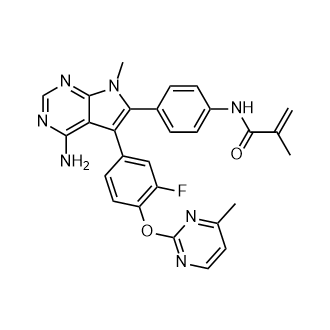
Lirafugratinib
CAS No. : 2549174-42-5
(Synonyms: RLY-4008)
| Size | Price | Stock |
|---|---|---|
| 5mg | $260 | In-stock |
| 10mg | $380 | In-stock |
| 25mg | $760 | In-stock |
| 50mg | $1200 | In-stock |
| 100mg | $1590 | In-stock |
| 1g | $4450 | In-stock |
| 5 g | Get quote | |
| 10 g | Get quote | |
| We match the lowest price on market. | ||
We offer a substantial discount on larger orders, please inquire via [email protected]
or Fax: (86)21-58955996
Inquiry for price and availability only. Please place your order via our email or fax.
| Cat. No. : | HY-147250 |
| M.Wt: | 509.53 |
| Formula: | C28H24FN7O2 |
| Purity: | >98 % |
| Solubility: | DMSO : 62.5 mg/mL (ultrasonic;warming;heat to 60°C) |
Lirafugratinib (RLY-4008) is an orally active, irreversible and highly selective FGFR2 inhibitor with an IC50 of 3 nM. Lirafugratinib covalently binds to Cys491. Lirafugratinib targets FGFR2 primary alterations and resistance mutations and induces tumor regression while sparing other FGFRs[1].
IC50 & Target:FGFR2[1]
In Vitro:Lirafugratinib (RLY-4008) has >250-fold selectivity over FGFR1, and >80- and >5,000-fold selectivity over FGFR3 and FGFR4, respectively. The reversible binding of Lirafugratinib promotes a rigid and extended P-loop in FGFR1 that disfavors covalent bond formation while minimally affecting the conformation of the P-loop in FGFR2, enabling efficient covalent bond formation and leading to FGFR2 selectivity[1].
Lirafugratinib (24h) induces dose-dependent cleavage of caspase-3 and poly (ADP-ribose) polymerase (PARP)-early markers of apoptosis[1].
Lirafugratinib (2h) demonstrates a dose-dependent reduction of phosphorylation of FGFR2 signaling pathway nodes, including FRS2, AKT, and ERK[1].
RLY-4008 inhibits cellular proliferation with IC50<14 nM in FGFR2-dependent cell lines including KATO III, SNU-16 and NCI-H716, ICC13-7, and MFE-296, FGFR2N549K and AN3CA, FGFR2K310R; N549K and JHUEM-2, FGFR2C383R[1].
In Vivo:Lirafugratinib (RLY-4008; 1-30 mg/kg; orally, twice daily; 15-30 days) demonstrates antitumor activity in FGFR2-altered cancer xenograft models[1].
Lorem ipsum dolor sit amet, consectetur adipisicing elit. Autem earum hic iste maiores, nam neque rem suscipit. Adipisci consequatur error exercitationem fugit ipsam optio qui, quibusdam repellendus sed vero! Debitis.
Inquiry Information- Product Name:
- Lirafugratinib
- Cat. No.:
- HY-147250
- Quantity:
Your information is safe with us.