
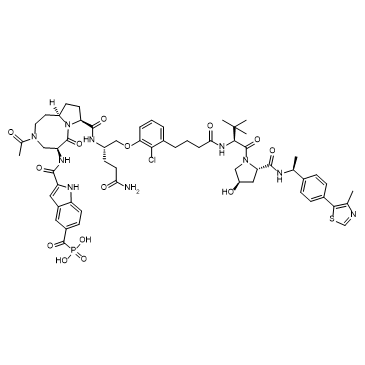
KT-333
CAS No. : 2502186-79-8
| Size | Price | Stock |
|---|---|---|
| 1mg | $500 | In-stock |
| 5mg | $1000 | In-stock |
| 10mg | $1400 | In-stock |
| 25mg | $2300 | In-stock |
| 50mg | $3220 | In-stock |
| 100 mg | Get quote | |
| 200 mg | Get quote | |
| We match the lowest price on market. | ||
We offer a substantial discount on larger orders, please inquire via [email protected]
or Fax: (86)21-58955996
Inquiry for price and availability only. Please place your order via our email or fax.
| Cat. No. : | HY-156730 |
| M.Wt: | 1257.78 |
| Formula: | C60H74ClN10O14PS |
| Purity: | >98 % |
| Solubility: |
KT-333 is a molecular glues that degrades STAT3 protein. KT-333 mediates the selective degradation of STAT3 through the ubiquitin-proteasome system by binding to STAT3 protein and E3 ubiquitin ligase von Hippel-Lindau protein (VHL). KT-333 has strong selectivity for STAT3 protein degradation and good antitumor activity. KT-333 can be used in the study of hematologic malignancies such as large granular lymphocytic leukemia (LGL-L), peripheral T-cell lymphoma (PTCL), and cutaneous T-cell lymphoma (CTCL)[1].
In Vitro: KT-333 (11.8±2.3 nM, 48 h) degrades STAT3 resulted in irreversible growth inhibition of SU-DHL-1 cell line and induces caspase 3/7 activity in the SU-DHL-1 cell line[1].
KT-333 has a good degradation effect on STAT3 protein, and in cell phenotypic analysis, its GI50 value in multiple ALCL cell lines ranges from 8.1 to 57.4 nM[1].
In Vivo: KT-333 (5, 10, 15 and 45 mg/kg, iv.; once a week for two weeks) exhibits dose-dependent antitumor activity. Female NOD SCID mice with xenograft tumors of SU-DHL-1 administered with 5 mg/kg achieved 79.9% tumor growth inhibition (TGI), while those administered 10, 15, or 45 mg/kg experienced complete tumor regression, with these effects sustained until the end of the study[1].
KT-333 (10, 20 and 30 mg/kg, iv.; once a week for two weeks) exhibits dose-dependent antitumor activity. Female NOD SCID mice with xenograft tumors of SUP-M2 administered with 10 mg/kg achieved 83.8% tumor growth inhibition (TGI), while those administered 20 or 30 mg/kg experienced complete tumor regression, with these effects sustained until the end of the study[1].
Lorem ipsum dolor sit amet, consectetur adipisicing elit. Autem earum hic iste maiores, nam neque rem suscipit. Adipisci consequatur error exercitationem fugit ipsam optio qui, quibusdam repellendus sed vero! Debitis.
Inquiry Information- Product Name:
- KT-333
- Cat. No.:
- HY-156730
- Quantity:
Your information is safe with us.