
AP39
CAS No. : 1429061-80-2
| Size | Price | Stock |
|---|---|---|
| 5mg | $100 | In-stock |
| 10mg | $170 | In-stock |
| 25mg | $350 | In-stock |
| 50mg | $600 | In-stock |
| 100mg | $1000 | In-stock |
| 200 mg | Get quote | |
| 500 mg | Get quote | |
| We match the lowest price on market. | ||
We offer a substantial discount on larger orders, please inquire via [email protected]
or Fax: (86)21-58955996
Inquiry for price and availability only. Please place your order via our email or fax.
| Cat. No. : | HY-126124 |
| M.Wt: | 721.77 |
| Formula: | C37H38BrO2PS3 |
| Purity: | >98 % |
| Solubility: | DMSO : 100 mg/mL (ultrasonic) |
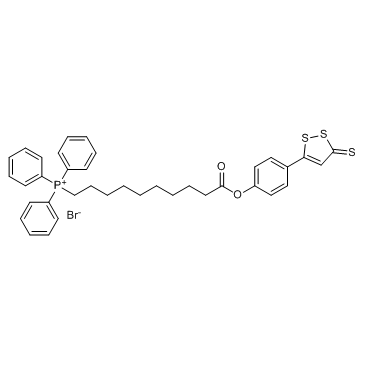
AP39 is a triphenylphosphonium derivatised anethole dithiolethione and mitochondria-targeting hydrogen sulfide (H2S) donor. AP39 increases intracellular H2S levels. AP39 exerts cytoprotective effects and maintains mitochondrial DNA integrity under oxidative stress conditions. AP39 protects against myocardial reperfusion injury in mice model and has the potential for Alzheimer's disease research[1][2][3].
In Vitro: AP39 (25,100?nM; for 24?h) results in increase in cell viability in APP/PS1 neurons and has no effect on cell viability in WT neurons[1].
AP39 (100?nM) increases the levels of OPA1 and Mfn1 but not Mfn2. Moreover, AP39 decreases the levels of Fis1 but not Drp1[1].
AP39 (25-250?nM; 2 h) induces a concentration-dependent increase in H2S generation and in the fluorescence of the H2S-detecting dye AzMC[1].
AP39 (100?nM) significantly increases the basal respiratory rate and the OCR-linked maximal respiratory capacity of the APP/PS1 neurons. AP39 significantly increases the ATP production in WT and APP/PS1 neurons. AP39 significantly protects against mtDNA damage in APP/PS1 neurons by partially restoring mtDNA integrity[1].
AP39 consists of a mitochondria-targeting motif, triphenylphosphonium (TPP+), coupled to a H2S-donating moiety (dithiolethione) by an aliphatic linker.
AP39 (100 nM) reduces intracellular oxidative stress and in the meantime it consequently sustaines the cell viability, mitochondrial respiration and mitochondrial DNA integrity. These effects tend to be stimulatory at lower concentrations (30 and 100 nM), but tend to diminish or convert into inhibitory effects at a higher concentration (300 nM)[2].
In Vivo: AP39 (100?nM/kg/day; ip; for 6 weeks) ameliorates the learning and memory deficits of APP/PS1 mice. AP39 (25-250?nM/kg/day; ip; for 6 weeks) induces a dose-dependent increase in H2S generation in the cortex and hippocampus of WT and APP/PS1 mice[1].
AP39 (0.01, 0.1, 1 μmol/kg; iv; bolus 10 min before reperfusion) dose-dependently reduces infarct size anaesthetized by thiobutabarbital (200 mg/kg, i.p) in male Sprague Dawley rats, 300-350 g (9-11 weeks)[3].
Lorem ipsum dolor sit amet, consectetur adipisicing elit. Autem earum hic iste maiores, nam neque rem suscipit. Adipisci consequatur error exercitationem fugit ipsam optio qui, quibusdam repellendus sed vero! Debitis.
Inquiry Information- Product Name:
- AP39
- Cat. No.:
- HY-126124
- Quantity:
Your information is safe with us.