
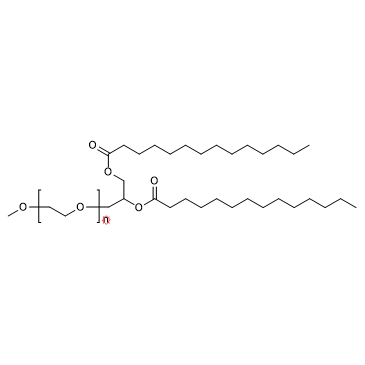
DMG-PEG
CAS No. : 1397695-86-1
| Size | Price | Stock |
|---|---|---|
| 100mg | $123 | Get quote |
| 250mg | $208 | Get quote |
| 1g | $556 | Get quote |
| 5 g | Get quote | |
| 10 g | Get quote | |
| We match the lowest price on market. | ||
We offer a substantial discount on larger orders, please inquire via [email protected]
or Fax: (86)21-58955996
Inquiry for price and availability only. Please place your order via our email or fax.
| Cat. No. : | HY-141674 |
| M.Wt: | 1000.00 |
| Formula: | N/A |
| Purity: | >98 % |
| Solubility: |
DMG-PEG is a lipid synthesized via myristoyl glyceride diester pegylation, with oral efficacy. DMG-PEG renders lPEI/DNA nanoparticles hydrophilic and electrically neutral, thereby enhancing their diffusivity and transport capacity in the gastrointestinal mucus layer. DMG-PEG is used to prepare liposomes for siRNA delivery, which can improve transfection efficiency. DMG-PEG maintains high-level glucagon-like peptide-1 (GLP-1) expression in the liver, lung and intestine of type 2 diabetic mouse models, and keeps blood glucose levels within the normal range. DMG-PEG can be used to prepare lipid nanoparticles for mRNA drugs[1].
In Vitro:DPPC/DMG-PEG/(lPEI/DNA) nanoparticles prepared with DMG-PEG (N/P ratio of 6-16 for 293T cells, N/P ratio of 14 for A549/HeLa cells; 24 h) show increased transfection efficiency in 293T cells with elevated N/P ratios. At an N/P ratio of 14 or higher, they reach a peak transfection efficiency of approximately 76% eGFP-positive cells in 293T cells, and exhibit high transfection efficiency in A549 and HeLa cells at an N/P ratio of 14[1].
In Vivo:DMG-PEG-coated DPPC/DMG-PEG/(lPEI/DNA) (NP-1-3) (150 μg DNA per mouse; p.o.; single administration) mediates significantly higher levels of transgene (luciferase and GLP-1) expression in the liver, lung and small intestine of normal Balb/c mice, and the expression persists for at least 24 h[1].
DMG-PEG coated DPPC/DMG-PEG/(lPEI/DNA) (NP-1-3) (150 μg GLP-1 plasmid DNA per mouse; p.o.; once every other day; 3 times in total over 6 days) effectively reduces and maintains blood glucose levels within the normal range in type 2 diabetic db/db mice, while also increasing plasma GLP-1 and insulin levels, improving liver and kidney functions, and causing no acute toxicity[1].
Lorem ipsum dolor sit amet, consectetur adipisicing elit. Autem earum hic iste maiores, nam neque rem suscipit. Adipisci consequatur error exercitationem fugit ipsam optio qui, quibusdam repellendus sed vero! Debitis.
Inquiry Information- Product Name:
- DMG-PEG
- Cat. No.:
- HY-141674
- Quantity:
Your information is safe with us.