
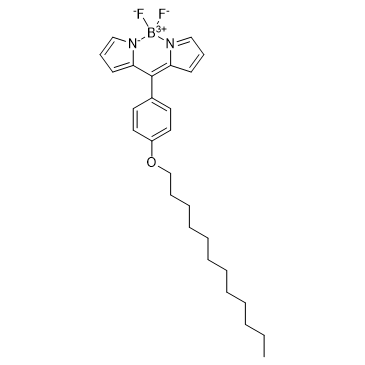
BODIPY-C12
CAS No. : 1029138-21-3
| Size | Price | Stock |
|---|---|---|
| 5mg | $160 | In-stock |
| 10mg | $256 | In-stock |
| 25mg | $512 | In-stock |
| 50 mg | Get quote | |
| 100 mg | Get quote | |
| We match the lowest price on market. | ||
We offer a substantial discount on larger orders, please inquire via [email protected]
or Fax: (86)21-58955996
Inquiry for price and availability only. Please place your order via our email or fax.
| Cat. No. : | HY-D1553 |
| M.Wt: | 452.39 |
| Formula: | C27H35BF2N2O |
| Purity: | >98 % |
| Solubility: | DMSO : 25 mg/mL (ultrasonic) |
BODIPY-C12 is a boron-dipyrromethene derivative containing a lipophilic tail (excitation 490 nm). BODIPY-C12 is a hydrophobic molecular and sensitivity to the surrounding environment and can be used to quantify viscosity, critical micelle concentration, and critical micelle temperature[1].
In Vitro:Multi-parameter characterization of amphiphilic polymers using BODIPY-C12[1]
1. Stock solution preparation:
1) Prepare an initial stock solution of BODIPY-C12 at a concentration of 1.32 mM in chloroform.
2. Dye working solution preparation:
1) Add the BODIPY-C12 stock solution to DPBS buffer to give a final concentration of BPC12 of 1.32 μM.
Remove residual chloroform by rotary evaporation at 22°C and 50 mBar pressure (or 37°C and 150 mBar pressure) for 5 min.
3. Specific staining steps:
3.1 Critical micelle concentration (CMC) determination:
1) Prepare 1 mM stock solutions of Pluronic P123 and F127.
2) Add different amounts of Pluronic polymer to DPBS buffer containing 1.32 μM BODIPY-C12. After each addition of polymer, remove the chloroform using a rotary evaporator and mix the solution thoroughly to ensure that the dye and copolymer are evenly distributed in the measurement solution. Repeat the evaporation and mixing steps to keep the volume of the measured sample and the concentration of the fluorescent probe constant.
3) Monitor the fluorescence intensity at 517 nm under an excitation wavelength of 490 nm using a steady-state fluorescence spectrometer. Plot a curve with polymer concentration as the horizontal axis and fluorescence intensity as the vertical axis. The polymer concentration corresponding to the turning point of the curve is the CMC.
3.2 Critical micelle temperature (CMT) determination staining steps
1) Prepare 3% w/v (5.2 mM) and 10% w/v (17 mM) solutions of P123, and 6% w/v (4.8 mM) and 10% w/v (7.9 mM) solutions of F127, all in DPBS, and add 6.6 μM BODIPY-C12.
2) Stir the above solutions at room temperature overnight to ensure that the polymer is completely dissolved and the chloroform is completely evaporated.
3) Monitor the fluorescence intensity at 517 nm using a steady-state fluorescence spectrometer with an excitation wavelength of 490 nm. Perform a temperature scan in the range of 4-25 °C with a step size of approximately 1 °C and record the change in fluorescence intensity at different temperatures. The temperature at which the fluorescence intensity stops increasing is the CMT.
3.3 Staining steps for intramicellar viscosity determination
1) Prepare micellar solutions of Pluronic P123 and F127 in DPBS at a concentration of 5 mM, which is much higher than the CMC of both polymers.
2) Test three different concentrations of BODIPY-C12 (1 μM, 5 μM, and 10 μM) at 22 °C and record the fluorescence intensity decay curves by a time-correlated single photon counting (TCSPC) system to confirm the absence of concentration quenching. The highest dye concentration (10 μM) was selected for viscosity measurement at 37 °C.
3) Plot a calibration curve of logτf versus logη in logarithmic form according to the modified Forster-Hoffman equation. Use the calibration curve to determine the intramicellar viscosity by measuring the fluorescence lifetime of BODIPY-C12 in micellar solution.
Lorem ipsum dolor sit amet, consectetur adipisicing elit. Autem earum hic iste maiores, nam neque rem suscipit. Adipisci consequatur error exercitationem fugit ipsam optio qui, quibusdam repellendus sed vero! Debitis.
Inquiry Information- Product Name:
- BODIPY-C12
- Cat. No.:
- HY-D1553
- Quantity:
Your information is safe with us.