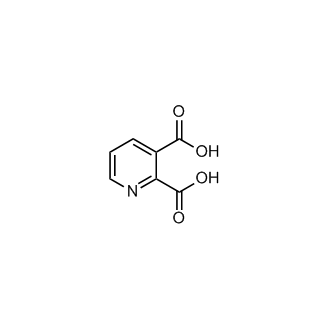
Quinolinic acid


CAS No. : 89-00-9

89-00-9
Price and Availability of CAS No. : 89-00-9
Size Price Stock
100g $12 In-stock
500g $33 In-stock
1000g $58 In-stock
> 2 kg Get quote
We match the lowest price on market.

We offer a substantial discount on larger orders, please inquire via [email protected]

or Fax: (86)21-58955996

Inquiry for price and availability only. Please place your order via our email or fax.

Cat. No. : HY-100807
M.Wt: 167.12
Formula: C7H5NO4
Purity: >98 %
Solubility: DMSO : 33.33 mg/mL (ultrasonic);H2O : 3.33 mg/mL (ultrasonic)
Introduction of 89-00-9 :

Quinolinic acid, an endogenous metabolite of tryptophan, is a N-methyl-D-aspartate receptor (NMDA receptor) agonist. Quinolinic acid increases glutamate efflux, induces the generation of ROS, activates nitric oxide synthase, produces excessive NO, leading to calcium ion influx and neuronal apoptosis[1][2][3][4][5][6][7][8]. IC50 & Target:NMDA Receptor[1] In Vitro:Quinolinic acid (0-50 mM, 24 h) decreases the percentage of survival cells ranging from 100% at 5 mM to 45.23% at 50 mM in N18D3 cells[2].
Quinolinic acid (1 mM, 0-0.5 h) rapidly increased [Ca²⁺]i in N18D3 cells, inducing an increase in NO production[2].
Quinolinic acid (30 mM, 6 h) upregulated the expression of the pro-apoptotic gene Caspase-9 in N18D3 cells and inhibited the phosphorylation of PI3K and GSK-3β[2].
Quinolinic acid (1-10 μM, 24 h) significantly antagonized Ro in hippocampal slices Neuroprotective effects of 61-8048 (HY-12347)[3].
Quinolinic acid (25-300 μM, 24 h) induced isolated neuronal death in rat brain tissue in a concentration-dependent manner[3][4].
In Vivo:Note:
Please do not refer to only one article to determine the experimental conditions. It is recommended to determine the optimal experimental conditions (animal strain, age, dosage, frequency and cycle, detection time and indicators, etc.) through preliminary experiments before the formal experiment.

Quinolinic acid (0.2-50 μg per mouse, intracerebroventricular injection; or 300-600 mg/kg, i.p., single dose) causes excitement of movement, clonic convulsions, a decrease in body temperature, and at high doses, severe convulsions and death[5].

Inducing Huntington's disease[6][7][8]
Background
Quinolinic Acid, as an agonist of NMDA receptors (NMDAR), excessively activates excitatory amino acid receptors, causing a large influx of calcium ions (Ca²⁺). The intracellular calcium overload triggers a series of toxic cascades, ultimately leading to neuroexcitatory toxicity and neuroinflammation.
Specific Modeling Methods
Rat: Male Wistar rat 300-350 g
Administration method: 240 nmol, dissolved in physiological saline, total volume 1 μL • Injection into the right striatum • Single dose
Mice: C57BL6/J (WT) mice • Female • 10-12 weeks old
Administration method: 30 nmol, dissolved in isotonic saline, total volume 1 μL • Injection into the right striatum • Single dose
Zebrafish: 3-4 month old adult zebrafish (Danio rerio) • Male and female • 450 mg
Administration method: 15 mM, 2.5 μL per fish • Intracerebroventricular injection (i.c.v.) • Single dose<>br
Note
(1) When performing stereotactic injection into the unilateral striatum of mice/rats, the injection speed must be controlled. The injection should be slowly administered within 2 minutes, and a needle should be left in place for 2 minutes after the injection to prevent the drug solution from flowing back along the needle path.
(2) After anesthetizing zebrafish with cold water, they are fixed on a sponge bed. The needle is inserted vertically into the right cerebral hemisphere (about 3 mm deep), and then the fish is returned to the aquarium to recover after the injection.
Modeling Indicators
Behavioral changes: Weight loss, motor dysfunction (rotating rod test, balance beam test), and impaired cognitive function.
Molecular changes: Lipid peroxidation products (MDA), nitrite (metabolites), pro-inflammatory cytokines and NF-κB, increased reactive oxygen species, decreased levels of antioxidant enzymes (SOD, Catalase) and reduced glutathione (GSH), mitochondrial dysfunction, etc.
Histological analysis: A large number of apoptotic cells (nuclear pyknosis) and vacuolation were observed in the striatum.
Correlated Product(s): /
Opposite Product(s): Ro 61-8048 (HY-12347)

Your information is safe with us.