
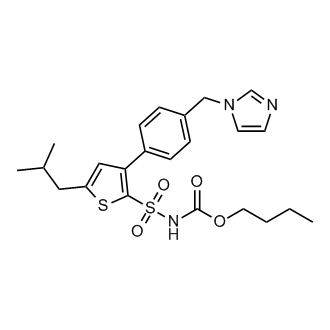
Buloxibutid
CAS No. : 477775-14-7
(Synonyms: AT2 receptor agonist C21)
| Size | Price | Stock |
|---|---|---|
| 5mg | $120 | In-stock |
| 10mg | $190 | In-stock |
| 25mg | $350 | In-stock |
| 50mg | $550 | In-stock |
| 100mg | $950 | In-stock |
| 500mg | $2100 | In-stock |
| 1g | $2950 | In-stock |
| 5 g | Get quote | |
| 10 g | Get quote | |
| We match the lowest price on market. | ||
We offer a substantial discount on larger orders, please inquire via [email protected]
or Fax: (86)21-58955996
Inquiry for price and availability only. Please place your order via our email or fax.
| Cat. No. : | HY-100113 |
| M.Wt: | 475.62 |
| Formula: | C23H29N3O4S2 |
| Purity: | >98 % |
| Solubility: | DMSO : 50 mg/mL (ultrasonic) |
Buloxibutid (AT2 receptor agonist C21) is an orally active, selective angiotensin II type 2 receptor (AT2R) agonist, with a Ki value of 0.4 nM for porcine AT2R. Buloxibutid exerts effects such as vasodilation, anti-inflammation, anti-fibrosis (promoting the expression of collagenase MMP-13) and tissue repair mainly by activating the NO/cGMP pathway, inhibiting the pro-proliferative MAPK signaling, and suppressing the pro-fibrotic TGF-β/Smad pathway as well as the inflammatory NF-κB pathway. Buloxibutid can be used in research related to idiopathic pulmonary fibrosis, hypertension, and systemic sclerosis[1][2][3][4].
IC50 & Target:Ki: 0.4 nM (AT2) and >10 µM (AT1)[1]
In Vitro:Buloxibutid (1-10 μM) inhibits the expression and signaling of proinflammatory pathways in LPS (HY-D1056)-induced THP-1 macrophages in a time- and concentration-dependent manner at concentrations of 1 and 10 μM[2].
Buloxibutid (Compound 21) (0.1-0.1 μM; 3 days) induces neurite outgrowth in NG108-15 cells by activating AT2 receptors. After treatment with 0.1 μM for 3 days, it increases the proportion of neurite-positive cells to 19.9%, and its signal transduction depends on the MAPK, cGMP and cGMP-dependent protein kinase pathways[4].
Buloxibutid (100 nM; 0-1 h) transiently activates p42/p44mapk in NG108-15 cells via activation of the AT2 receptor, and its phosphorylation level increases by 2.2-fold after treatment with 0.1 μM for 30 min[4].
In Vivo:Buloxibutid (0.03 mg/kg/day; i.p.; daily administration; for 2 consecutive weeks) prevents and reverses bleomycin (HY-108345)-induced pulmonary fibrosis, vascular remodeling and inflammatory responses in Sprague-Dawley rats[2].
Buloxibutid (0.3 mg/kg/day; mini pump; daily administration; for 7 consecutive days) alleviates bleomycin-induced pulmonary fibrosis in rats[2].
Buloxibutid (1 mg/kg; i.p.; single administration) attenuates lung injury and inflammation induced by ventilator-induced lung injury (VILI) in Sprague-Dawley rats[2].
Buloxibutid (0.3 mg/kg/day; i.p.; daily) alleviates LPS-induced acute lung injury in C57Bl/6 mice[2].
Buloxibutid (0.3 mg/kg/day; i.p.; daily administration) alleviates hyperoxia-induced acute lung injury in C57Bl/6 mice[2].
Buloxibutid (0.1-1 mg/kg/day; i.p.; administered daily for 7 consecutive days) reduces acute cigarette smoke-induced inflammation in female BALB/c mice, with the maximum efficacy observed at a dose of 0.3 mg/kg/day[2].
Buloxibutid (0.3 mg/kg/day; i.p.; daily administration; for 3 consecutive weeks) reduces chronic cigarette smoke-induced inflammation, epithelial injury and profibrotic responses, while improving pulmonary function in BALB/c mice[2].
Buloxibutid (0.03 mg/kg/day; i.p.; daily administration for 2 consecutive weeks) reverses monocrotaline-induced pulmonary fibrosis and myocardial fibrosis in male Sprague-Dawley rats[2].
Buloxibutid (0.03 mg/kg; i.p.; once daily; for 14 consecutive days) significantly reduces systolic blood pressure, diastolic blood pressure, and mean blood pressure by 34.4%, 40.2%, and 38.0%, respectively, in male Sprague Dawley rats with hypertension induced by L-NAME/NaCl. It also improves the antioxidant status of the heart and aorta, alleviates histopathological damage to cardiac tissue, and restores normal aortic structure[3].
Buloxibutid (0.03 mg/kg; i.p.; daily; 14 days) combined with Empagliflozin (HY-15409) significantly improves the antioxidant status of the heart and aorta in male Sprague Dawley rats with hypertension induced by L-NAME/NaCl, reduces aortic MDA levels by 27.5%, restores normal aortic structure, alleviates cardiac histopathological damage, and exerts a synergistic effect on aortic SOD and CAT activities[3].
Buloxibutid (Compound 21) (0.003-0.3 mg/kg/h; i.v.; continuous infusion; 100 μM; intraluminal perfusion) dose-dependently enhances duodenal mucosal alkaline secretion in male Sprague-Dawley rats via activation of the AT2 receptor, with the maximal effect observed at an intravenous dose of 0.3 mg/kg/h[4].
Buloxibutid (0.008-4 mg/kg; i.v.; single bolus) induces a significant AT2 receptor-mediated reduction in mean arterial pressure at intravenous doses of 0.008 mg/kg and 0.05 mg/kg in anesthetized spontaneously hypertensive rats[4].
Lorem ipsum dolor sit amet, consectetur adipisicing elit. Autem earum hic iste maiores, nam neque rem suscipit. Adipisci consequatur error exercitationem fugit ipsam optio qui, quibusdam repellendus sed vero! Debitis.
Inquiry Information- Product Name:
- Buloxibutid
- Cat. No.:
- HY-100113
- Quantity:
Your information is safe with us.