
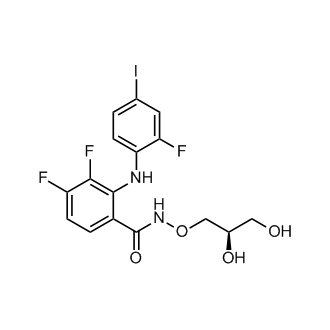
Mirdametinib (GMP)
CAS No. : 391210-10-9
(Synonyms: PD0325901 (GMP); PD325901 (GMP))
| Size | Price | Stock |
|---|---|---|
| 100 mg | Get quote | |
| 250 mg | Get quote | |
| 500 mg | Get quote | |
| We match the lowest price on market. | ||
We offer a substantial discount on larger orders, please inquire via [email protected]
or Fax: (86)21-58955996
Inquiry for price and availability only. Please place your order via our email or fax.
| Cat. No. : | HY-10254G |
| M.Wt: | 482.19 |
| Formula: | C16H14F3IN2O4 |
| Purity: | >98 % |
| Solubility: | 10 mM in DMSO |
Mirdametinib (PD0325901) (GMP) is Mirdametinib (HY-10254) produced by using GMP guidelines. GMP small molecules works appropriately as an auxiliary reagent for cell therapy manufacture. Mirdametinib is an orally active, selective and non-ATP-competitive MEK inhibitor[1][2][3]. In Vitro: Mirdametinib (250 nM; 7 d) induces differentiation of cardiac PCs into vascular smooth muscle cell (VSMC)-like cells[1]. Mirdametinib (10 μM; 4 d) induces oligodendrocyte precursor cells (OPC) to oligodendrocytes (OL) differentiation[2]. Mirdametinib enhances embryonic stem cells (ESC) self-renewal capacity both by key regulatory genes and ES cell-specific miRNA, which in turn influences ESC self-renewal and cellular differentiation[3].
Lorem ipsum dolor sit amet, consectetur adipisicing elit. Autem earum hic iste maiores, nam neque rem suscipit. Adipisci consequatur error exercitationem fugit ipsam optio qui, quibusdam repellendus sed vero! Debitis.
Inquiry Information- Product Name:
- Mirdametinib (GMP)
- Cat. No.:
- HY-10254G
- Quantity:
Your information is safe with us.