
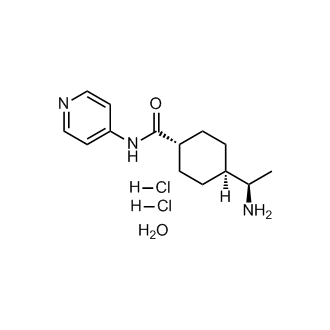
Y-27632 (hydrochloride hydrate)
CAS No. : 331752-47-7
| Size | Price | Stock |
|---|---|---|
| 5mg | $50 | In-stock |
| 10mg | $70 | In-stock |
| 25mg | $100 | In-stock |
| 50mg | $175 | In-stock |
| 100mg | $300 | In-stock |
| 200 mg | Get quote | |
| 500 mg | Get quote | |
| We match the lowest price on market. | ||
We offer a substantial discount on larger orders, please inquire via [email protected]
or Fax: (86)21-58955996
Inquiry for price and availability only. Please place your order via our email or fax.
| Cat. No. : | HY-10071A |
| M.Wt: | 338.27 |
| Formula: | C14H25Cl2N3O2 |
| Purity: | >98 % |
| Solubility: |
Y-27632 hydrochloride hydrate is a ROCK inhibitor with Ki values of 220 nM and 300 nM for ROCK1 and ROCK2, respectively. Y-27632 hydrochloride hydrate exerts anti-inflammatory and immunomodulatory effects in systemic lupus erythematosus models by inhibiting the ROCK/NF-κB pathway. Y-27632 hydrochloride hydrate enhances autophagy by inhibiting the AKT/mTOR pathway, thereby inducing apoptosis apoptosis in oral squamous cell carcinoma. Y-27632 hydrochloride hydrate induces the formation of tunneling nanotubes in ARPE-19 cells and significantly enhances mitochondrial transfer through these channels. Y-27632 hydrochloride hydrate promotes neurite outgrowth in PC12 cells by activating the Rac1/NOX1/ROS/AKT/PAK1 signaling cascade[1][2][3][4][5][6].
IC50 & Target:Ki: 220/300 nM (ROCK-I/II)[1]
In Vitro:Y-27632 (10 μM; 24-72 h) hydrochloride hydrate significantly reduces the viability of CAL-27, SCC-4 and SCC-9 oral squamous cell carcinoma (OSCC) cells[2].
Y-27632 (10 μM; 24 h) hydrochloride hydrate significantly inhibits the migration of CAL-27, SCC-4 and SCC-9 cells[2].
Y-27632 (10 μM; 6-24 h) hydrochloride hydrate inactivates the AKT/mTOR pathway, reduces the levels of phosphorylated downstream effectors, and increases the levels of apoptosis markers in OSCC cells[2].
Y-27632 (10 μM) hydrochloride hydrate induces autophagy in OSCC cells by inhibiting the mTOR pathway and promoting the conversion of LC3-I to LC3-II[2].
Y-27632 (10-50 μM; 5 min-3 h) hydrochloride hydrate induces dose- and time-dependent neurite outgrowth in PC12 cells via the Rac1/NOX1/ROS/AKT/PAK1 signaling cascade[4].
Y-27632 (10-1000 μM; 24 h) hydrochloride hydrate dose-dependently promotes the formation of F-actin/tubulin-containing Y-NTs (average length 30 µm) in ARPE19 retinal pigment epithelial cells and increases the mitochondrial transfer rate; this effect also exists under photodamage conditions, and mitochondrial transfer depends on direct contact between cells[5].
Y-27632 (40 μM; 24 h) hydrochloride hydrate induces cytoskeleton remodeling and morphological changes (increased cell area, enhanced contour length and pseudopodium formation) in ARPE19 retinal pigment epithelial cells, without altering the protein expression of F-actin or α-tubulin[5].
Y-27632 (40 μM; 24 h) hydrochloride hydrate alters mitochondrial distribution to an infiltrative and axon-like pattern, enhances mitochondrial mobility, upregulates miro1 mRNA expression, and increases the number and length of individual mitochondria in ARPE19 retinal pigment epithelial cells[5].
Y-27632 (10-1000 μM; 24 h) hydrochloride hydrate reduces the viability and promotes the apoptosis of ARPE19 retinal pigment epithelial cells only when the concentration exceeds 40 μM, and exerts no significant effects at concentrations of 10 μM, 20 μM or 40 μM[5].
Y-27632 (40 μM; 24 h) hydrochloride hydrate induces Y-shaped nanotubes (Y-NTs) in ARPE19 retinal pigment epithelial cells, a process that depends primarily on F-actin; in contrast, Y-27632-enhanced mitochondrial transport via Y-NTs relies on both F-actin and microtubules[5].
In Vivo:Y-27632 (5 mg/kg; i.v.; single dose) reduces pro-inflammatory cytokine levels, increases anti-inflammatory cytokine levels, restores Treg cell populations, and suppresses NF-κB pathway activation in lupus-prone MRL/lpr mice, exerting protective effects against systemic lupus erythematosus[1].
Y-27632 (10 mg/kg; i.p.; daily; 21 days) suppresses oral squamous cell carcinoma xenograft growth in nude mice, reducing proliferative tumor cells to 51% without inducing significant toxicity[2].
Y-27632 (5 mg/kg; continuous; 5 days post-I/R) attenuates myocardial ischemia-reperfusion injury in male Sprague-Dawley rats, reducing myocardial infarct size to ~20% of whole heart area and suppressing inflammation, apoptosis, and activation of MAPK and NF-κB signaling pathways[3].
Lorem ipsum dolor sit amet, consectetur adipisicing elit. Autem earum hic iste maiores, nam neque rem suscipit. Adipisci consequatur error exercitationem fugit ipsam optio qui, quibusdam repellendus sed vero! Debitis.
Inquiry Information- Product Name:
- Y-27632 (hydrochloride hydrate)
- Cat. No.:
- HY-10071A
- Quantity:
Your information is safe with us.