
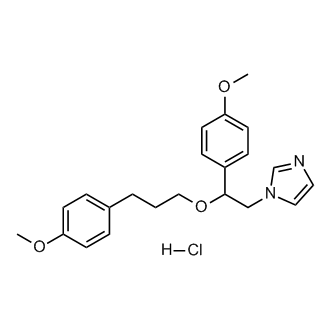
SKF-96365 (hydrochloride)
CAS No. : 130495-35-1
| Size | Price | Stock |
|---|---|---|
| 5mg | $66 | In-stock |
| 10mg | $110 | In-stock |
| 50mg | $429 | In-stock |
| 100mg | $715 | In-stock |
| 200 mg | Get quote | |
| 500 mg | Get quote | |
| We match the lowest price on market. | ||
We offer a substantial discount on larger orders, please inquire via [email protected]
or Fax: (86)21-58955996
Inquiry for price and availability only. Please place your order via our email or fax.
| Cat. No. : | HY-100001 |
| M.Wt: | 402.91 |
| Formula: | C22H27ClN2O3 |
| Purity: | >98 % |
| Solubility: | H2O : 100 mg/mL (ultrasonic) |
SKF-96365 hydrochloride is a TRPC channel antagonist and store-operated calcium entry (SOCE) inhibitor. SKF-96365 hydrochloride reduces calcium ion influx by inhibiting the activity and expression of TRPC6, STIM1 and Orai1. SKF-96365 hydrochloride inhibits voltage-gated sodium current (cardiac INa/NaV1.5) and slows myocardial conduction. SKF-96365 hydrochloride inhibits phosphorylation/activation of CaMKIIγ and suppresses the downstream AKT signaling pathway. SKF-96365 hydrochloride induces G2/M phase cell cycle arrest, apoptosis and cytoprotective autophagy in colorectal cancer cells. SKF-96365 hydrochloride alleviates allergic rhinitis symptoms by reducing inflammatory cytokine levels. SKF-96365 hydrochloride reduces intracellular calcium overload, inhibits Homer1 expression, prevents nuclear damage and suppresses apoptosis. SKF-96365 hydrochloride inhibits the growth of colorectal cancer xenografts in nude mice. SKF-96365 hydrochloride is applicable to research related to allergic rhinitis, colorectal cancer, Parkinson's disease, persistent spontaneous nociception and hyperalgesia[1][2][3][4][5].
In Vitro:SKF-96365 (0-10 μM; applied until steady-state inhibition is reached) hydrochloride inhibits hNaV1.5 currents stably expressed in HEK 293 cells, with an IC50 of 0.94 μM[2].
SKF-96365 (0-20 μM) hydrochloride dose-dependently inhibits store-operated calcium entry in human colorectal cancer cell lines HCT116 and HT29[3].
SKF-96365 (0-40 μM, 48-72 h) hydrochloride inhibits the growth of human colorectal cancer cells HCT116 (IC50 = 10.88 μM) and HT29 (IC50 = 14.56 μM), and exhibits significantly lower toxicity against normal colonic epithelial cells NCM460[3].
SKF-96365 (0-20 μM, 48 h) hydrochloride induces G2/M cell cycle arrest in human colorectal cancer cells HCT116 and HT29 by regulating key G2/M transition proteins, including upregulating p21waf/Cip1 and downregulating p-Cdc25c, Cdc25c, and Cyclin B[3].
SKF-96365 (10 μM, 0-24 h) hydrochloride induces apoptosis in human colorectal cancer cell lines HCT116 and HT29 via the endogenous mitochondrial pathway, a process characterized by early (12 h) mitochondrial membrane depolarization, Bax translocation and cytochrome c release, followed by caspase activation and marked apoptosis (24 h)[3].
SKF-96365 (0-20 μM, 12 h) hydrochloride induces cytoprotective autophagy in human colorectal cancer cells HCT116 and HT29. This effect appears as early as 12 h (prior to apoptosis) and antagonizes apoptosis by sequestering mitochondria into autophagosomes to reduce cytosolic cytochrome c levels[3].
SKF-96365 (0-20 μM, 24 h) hydrochloride inhibits the AKT/mTOR signaling pathway and the calcium/Ca2+/CaMKIIγ/AKT signaling pathway in human colorectal cancer cell lines HCT116 and HT29[3].
SKF-96365 (1-50 μM, 24 h) hydrochloride significantly increases the survival rate of PC12 cells treated with MPP+, reduces LDH release, alleviates nuclear damage, membrane damage, and late apoptotic cell death, mitigates intracellular calcium overload, and decreases the mRNA and protein expression levels of Homer1[4].
SKF-96365 (1-10 µM) hydrochloride inhibits melittin-induced inward currents in acutely isolated small and medium-sized dorsal root ganglion cells of rats in a dose-dependent manner[5].
SKF-96365 (10 µM) hydrochloride inhibits melittin-induced intracellular Ca2+ elevation, and the proportion of cells exhibiting this inhibitory effect reaches 46.5% in acutely isolated rat dorsal root ganglion cells sensitive to melittin[5].
In Vivo:SKF-96365 (200-400 μg; intranasal administration; once daily; for 8 consecutive days) hydrochloride dose-dependently alleviates allergic rhinitis symptoms and suppresses inflammatory responses in BALB/c mice[1].
SKF-96365 (20 mg/kg; i.p.; once daily for 14 consecutive days) hydrochloride inhibits the growth of colorectal cancer xenografts in athymic BALB/c nude mice by inducing cell cycle arrest, apoptosis and protective autophagy via suppressing the CaMKIIγ/AKT-mediated pathway[3].
Lorem ipsum dolor sit amet, consectetur adipisicing elit. Autem earum hic iste maiores, nam neque rem suscipit. Adipisci consequatur error exercitationem fugit ipsam optio qui, quibusdam repellendus sed vero! Debitis.
Inquiry Information- Product Name:
- SKF-96365 (hydrochloride)
- Cat. No.:
- HY-100001
- Quantity:
Your information is safe with us.